Multicolumn Distillation Plant
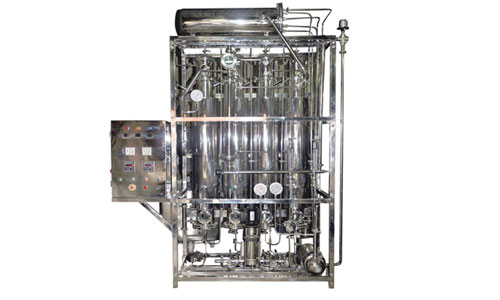
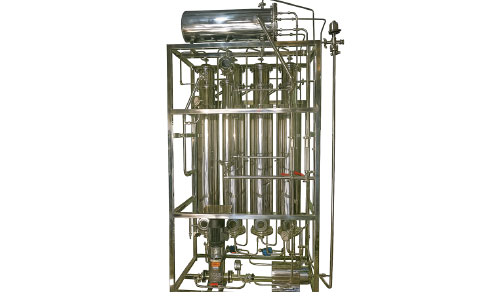
A Multi Column Distillation Plant converts feed water into pyrogen-free Water for Injection (WFI) by evaporating it through a series of columns, each one reusing the heat of the column before it. Plant steam is the only external heat source, and the process leaves impurities and endotoxins behind while clean distillate is collected.
WFI is the most demanding water grade in a pharmaceutical facility. It goes into injectables and rinses product-contact equipment, and its endotoxin limit is strict enough that one excursion can cost a whole batch.
This WFI distillation plant is built for operations that cannot accept that risk. It delivers distillate to USP, BP and IP norms, diverts sub-standard water automatically, and needs far less heating energy than a single-effect still. Capacities run from a laboratory model of 80 LPH up to 1000 LPH.
How a Multi Column Distillation Plant Works
A multi-effect distillation plant is a set of evaporator columns arranged in series. Each column runs at a slightly lower pressure and temperature than the one before, which lets the vapour from one stage heat the next. Only the first column needs raw plant steam.
Step by step
- Feed water preheating: Incoming feed water passes through the condenser and preheaters, picking up heat that would otherwise be lost to the cooling circuit.
- First-column evaporation: The feed flows as a thin film down the inside of the heat-exchanger tubes while plant steam heats them from outside. Roughly one third of the feed flashes into vapour.
- Droplet and endotoxin separation: The fast-moving vapour is forced through a spiral path and a 180° turn. Centrifugal action throws entrained droplets, and the endotoxins they carry, to the column wall, where they drain away with the unevaporated water.
- Heat reuse in the next column: The clean vapour becomes the heating medium for the second column, where it condenses into distillate. The remaining feed water cascades down and is partly evaporated in turn.
- Repetition down the series: Steps 3 and 4 repeat in every column, each at lower pressure and temperature, so the same heat does useful work several times.
- Final condensation and collection: Vapour from the last column is condensed by feed water and cooling water. The combined distillate is collected as WFI, and non-condensable gases are vented.
Built-in quality safeguards
Conductivity and temperature sensors check the distillate continuously. If a reading drifts out of range, the plant automatically sends the water to drain instead of to the storage tank. Concentrated impurities leave the system as continuous blowdown from the final column, so nothing accumulates between runs.
Key Features
Every Multi Column Distillation Plant combines heat recovery, droplet separation and automatic quality control in one compact unit.
- Pyrogen-free output: Centrifugal separation inside each column strips endotoxin-bearing droplets from the vapour before it condenses.
- Pharmacopoeia-grade distillate: The plant produces water that meets USP, BP and IP requirements for Water for Injection.
- Automatic diversion: Distillate that falls outside the set limits is sent to drain, so only compliant water reaches storage.
- Fully automatic operation: Start-up, running and shutdown follow a programmed sequence that keeps operator input to a minimum.
- High energy efficiency: Heat is passed from column to column, so only a fraction of the feed needs live raw steam.
- Compact footprint: The vertical column layout fits into utility rooms where floor space is tight.
- Sanitary construction: Special sanitary fittings and a high degree of internal finish limit places where microbes can settle.
- Calibrated instrumentation: Temperature, pressure and conductivity are measured at the critical points with calibrated instruments.
- Laboratory and custom models: A lab-scale unit is available, and capacity or layout can be tailored to a specific site, including pure steam and distilled water from one unit.
Technical Specifications
These specifications describe the Multi Column Distillation Plant range for pharmaceutical use. Final values are confirmed against your site utilities at the quotation stage.
| Parameter | Specification |
|---|---|
| Model / nominal capacity | 80, 150, 300, 500 and 1000 litres per hour (at 3 bar plant steam); 50 litres per hour laboratory model available |
| Output at higher steam pressure | Up to 230, 450, 760 and 1600 litres per hour at 6 bar, respectively |
| Number of columns | Up to 5 multi-effect stills |
| Output water quality | Water for Injection to USP, BP and IP norms |
| Distillate limits (pharmacopoeia WFI) | Conductivity below 1.3 µS/cm at 25 °C, TOC below 500 ppb, endotoxin below 0.25 EU/mL |
| Feed water requirement | DM Water |
| Plant raw steam pressure | 3 bar |
| Cooling water | 130 to 1250 litres per hour depending on model and steam pressure (see consumption data below) |
| Materials of construction | SS 316/316L for all WFI and pure steam contact parts; SS 304 for non-contact parts |
| Test certificates supplied | Internal surface finish Ra 0.8 µm or better |
| Joints and fittings | Special sanitary fittings; Orbital welding with borescope records available |
| Instrumentation | Calibrated temperature, pressure and conductivity measurement at critical points |
| Automation / control | Fully automatic operation with auto-dump of sub-standard distillate; PLC, HMI, SCADA available |
| Distillate outlet temperature | 90-100 deg C |
| Electrical supply and compressed air | Validation documents DQ, IQ and OQ provided |
| Certificates | Material test certificates; compliance and quality certificates for pumps, valves and fittings; calibration certificates for pressure gauges, temperature sensors and conductivity sensor |
Consumption data
| Steam Pressure | Steam Consumption(kg) | Feed Water(L) | Cooling Water(L) | Output | ||||
|---|---|---|---|---|---|---|---|---|
| Model | 150 L | 300 L | 150 L | 300 L | 150 L | 300 L | 150 L | 300 L |
| At 3 bar | 50 | 98 | 171 | 345 | 130 | 300 | 150 | 300 |
| At 4 bar | 60 | 121 | 206 | 415 | 170 | 380 | 180 | 350 |
| At 5 bar | 70 | 145 | 240 | 485 | 200 | 400 | 200 | 400 |
| At 6 bar | 80 | 165 | 265 | 530 | 230 | 460 | 230 | 450 |
| Steam Pressure | Steam Consumption(kg) | Feed Water(L) | Cooling Water(L) | Output | ||||
|---|---|---|---|---|---|---|---|---|
| Model | 500 L | 1000 L | 500 L | 1000 L | 500 L | 1000 L | 500 L | 1000 L |
| At 3 bar | 130 | 240 | 575 | 1150 | 250 | 900 | 500 | 1000 |
| At 4 bar | 160 | 300 | 695 | 1390 | 325 | 1000 | 600 | 1200 |
| At 5 bar | 192 | 355 | 795 | 1600 | 395 | 1100 | 700 | 1400 |
| At 6 bar | 220 | 455 | 390 | 1955 | 440 | 1250 | 760 | 1600 |
Benefits of a Multi Column Distillation Plant
Every Multi Column Distillation Plant combines heat recovery, droplet separation and automatic quality control in one compact unit.
- Lower steam bills: Only about a third of the feed is evaporated with live steam, and the published data shows roughly 0.24 to 0.35 kg of plant steam per litre of WFI.
- Modest cooling water demand: In the published consumption data, the plant uses at most about one litre of cooling water for each litre of distillate.
- Repeatable endotoxin removal: Every column separates droplets from vapour the same way on every run, so water quality does not depend on operator skill.
- Batch protection: Out-of-limit distillate is diverted before it can reach the storage tank or the loop.
- No compressor to maintain: The distillation columns are static, which keeps wear parts, vibration and service calls to a minimum.
- Small footprint: A vertical column arrangement saves floor area in utility rooms and in retrofit projects.
- Quiet, steady operation: Automatic control holds output stable without constant adjustment.
- Simple validation path: Calibrated instruments, material certificates and DQ, IQ and OQ support reduce the effort of qualification.
Applications
The Multi Column Distillation Plant suits any site that needs a dependable supply of hot, pyrogen-free water. Typical uses include:
- Injectable and parenteral formulations: WFI for compounding, dilution and final product water in vials, ampoules and large-volume parenterals.
- Vaccines and biologics: Buffer and media preparation, and water for rinsing in upstream and downstream processing.
- Ophthalmic preparations: Sterile eye drops and irrigation solutions where endotoxin control matters.
- API manufacturing: Final rinse and process water for sterile active pharmaceutical ingredients.
- Hospital and healthcare units: In-house production of water for injection-grade solutions and sterile services.
- Equipment cleaning and rinsing: Final rinse of tanks, filling lines, vials and bungs after cleaning.
- Laboratories and life sciences: The laboratory model supports R&D, quality control and pilot work.
Documentation and Quality assurance
- Validation support: Design Qualification (DQ), Installation Qualification (IQ) and Operational Qualification (OQ) documents are provided.
- Material traceability: Test certificates accompany the materials of construction.
- Instrument calibration: Temperature, pressure and conductivity instruments are tested and calibrated before dispatch.
- Component certificates: Pumps, valves and fittings come with certificates of compliance and quality.
- Surface finish reports: Surface roughness and electropolishing reports for contact surfaces
Optional Accessories
A distillation plant is one part of a complete WFI system. These add-ons can be supplied with the plant or specified separately.
- WFI storage tank: Sanitary tank sized to the plant's output, built to the same finish standard as the distiller.
- Pure steam from the same unit: A combined configuration that gives both pure steam and distilled water from one plant.
- Double tube sheet preheaters and coolers: Available for 150-1000 LPH models
- PLC/SCADA package with data logging: 21 CFR Part 11 features, remote access
- Custom capacity or low-volume design: Built to individual site specifications.