Syrup Manufacturing Plant
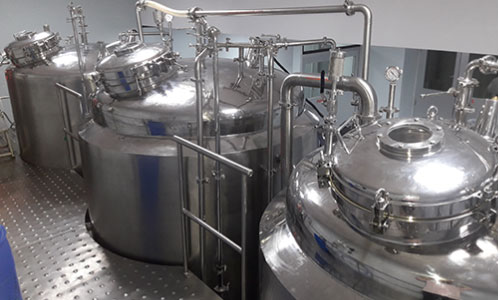
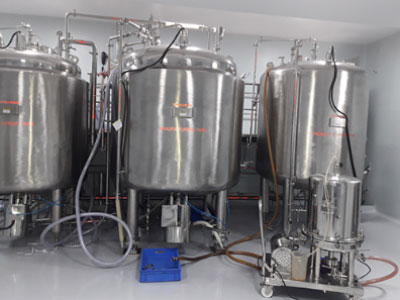
A syrup manufacturing plant is the processing system at the heart of oral liquid production. It takes sugar, purified water and active ingredients through dissolution, filtration, blending and transfer inside one controlled, hygienic line. SA Pharma Process Equipment designs and builds these plants in stainless steel for formulation heads, plant managers, procurement teams and validation engineers who need repeatable batches, easy cleaning and documents that stand up to audits.
Capacities typically range from 500 L to 10,000 L, with manual, semi-automatic or PLC-HMI control. The layout can be matched to your room height, utilities and product mix.
What is a pharmaceutical syrup manufacturing plant?
It is a purpose-built set of vessels, pumps, filters and controls that turns raw materials into a clear, uniform oral liquid ready for filling. The end-to-end process covers sugar dissolution, syrup preparation, filtration, mixing or blending, and transfer to storage tank and the filling line.
A dedicated oral liquid manufacturing plant matters because syrups are high in sugar and prone to microbial growth, so closed transfers, smooth contact surfaces and cleanable design directly protect product quality. It also keeps batch times, temperatures and agitation within defined limits, which is hard to achieve in general-purpose tanks.
How the plant works: process flow
- Charging: Sugar and purified water are loaded into the sugar melting vessel, by hand or through a vacuum or closed transfer system.
- Dissolution: The agitator and heating (steam or electric) bring the mixture to the set temperature until the sugar dissolves fully. Activated carbon can be used where extra clarity is needed.
- Pre-filtration: The hot syrup passes through a basket filter and is pumped, or drawn by vacuum, into the manufacturing vessel.
- Blending: Active ingredients, flavours, colours and preservatives are added under controlled agitation and temperature.
- Homogenization: For suspensions or products needing a uniform dispersion, an inline or bottom mount homogenizer treats the batch.
- Polish filtration: A zero hold-up filter press or similar unit removes remaining fine particles.
- Storage: The finished syrup moves to a storage vessel with a stirrer, ready for sampling and release.
- Transfer: Pumps send the product through sanitary piping to the filling line.
Key components of the plant
- Sugar charging and transfer system: Moves sugar from stores to the melting vessel with less manual handling.
- Sugar melting vessel: Jacketed or limpet-coil vessel with a stirrer for dissolving sugar at set temperature.
- Basket filter and transfer pump: Removes coarse particles before syrup enters the manufacturing vessel.
- Syrup manufacturing vessel: Agitated vessel for blending actives and excipients, with heating and cooling.
- Inline homogenizer: Gives uniform dispersion where the formulation needs it.
- Zero hold-up filter press (sparkler type): Polishes the syrup with minimal product loss. [Internal Link: zero hold-up sparkler filter press]
- Storage vessel with stirrer: Holds the approved batch before filling. [Internal Link: stainless steel storage tanks]
- Transfer pumps and interconnecting piping: Sanitary pumps and electropolished SS 316 pipework between stages.
- Working platform: Gives operators safe access for charging, sampling and maintenance.
- Control panel: Central panel for temperature, agitator speed and level, from push-button to PLC-HMI.
- CIP/SIP provisions (optional): Supports in-place cleaning and sanitization between batches.
Technical Specifications
| Parameter | Typical specification | Customizable |
|---|---|---|
| Capacity | 500 L to 10,000 | Yes |
| Product-contact material | SS 316L or SS 316 | Grade on request |
| Non-contact parts | SS 304 | Yes |
| Piping | Electropolished SS 316 interconnecting pipes | Yes |
| Surface finish | Ra 0.8 um or better | Yes |
| Heating and cooling | Steam or electric heating; jacket or limpet coil for heating and cooling | Yes |
| Operating temperature | Ambient to about 100 °C | Per process |
| Agitator | Propeller or anchor; bottom-entry, top or magnetic drive; optional high-speed disperser or rotor-stator; VFD speed control | Yes |
| Shaft sealing | Single or double mechanical seal with water flow switch | Yes |
| Gaskets | Pharma-grade silicone | Material on request |
| Motor and power rating | Sized to batch volume and viscosity | Yes |
| Filtration | Basket or bag filter on melt line; zero hold-up filter press before storage | Yes |
| Transfer method | Vacuum transfer or sanitary pumps | Yes |
| Level control | Capacitance probe or load cells | Yes |
| Automation | Manual, semi-automatic or PLC with HMI touch screen; SCADA optional | Yes |
| Cleaning | Spray balls in each vessel; CIP/SIP optional | Yes |
| Design basis | cGMP; ASME BPE practices where specified | Per project |
| Documentation | DQ, IQ, OQ, PQ, material certificates; FAT/SAT on request | Yes |
Key features and benefits
- GMP-oriented design gives smooth, cleanable surfaces and lower contamination risk.
- SS 316L contact parts resist corrosion from sugar solutions and cleaning agents.
- Bottom-entry agitators with mechanical seals keep the product zone sealed and avoid drive couplings that raise upkeep.
- Spray balls in every vessel cut cleaning time and make routine cleaning more repeatable.
- Steam or electric heating lets you use existing utilities and hold the batch at a stable temperature.
- Dedicated filtration stages give clearer syrup and protect downstream filling equipment.
- PLC-HMI control records and holds time, temperature, speed and level for batch consistency.
- Platform-mounted layout improves operator access and keeps maintenance safe.
Applications
- Syrups, cough syrups and vitamin syrups
- Antacid and other oral suspensions
- Tonics, expectorants and drop solutions
- Ayurvedic and herbal syrups
It is used by pharmaceutical formulators, nutraceutical and healthcare brands, and contract manufacturers. The same sugar-syrup section also serves food and beverage lines when specified.
Compliance and quality
- cGMP alignment: Vessel layout, surface finish and cleanability follow cGMP principles.
- Contact materials: SS 316L or SS 316 for product-contact parts, supported by material test certificates.
- Validation documents: DQ, IQ, OQ and PQ protocols, with FAT and SAT support on request.
- Data integrity: PLC or SCADA systems can be configured for audit trails and 21 CFR Part 11 needs when specified.
Why choose SA Pharma Process Equipment?
- Process engineering: Layouts are drawn around your formulation, batch size and room, not a fixed catalogue size.
- Fabrication control: In-house fabrication of vessels, piping and platforms.
- Installation and commissioning: Site support from erection to trial batches across India.
- Documentation: Validation-ready documents delivered with the plant.
- After-sales support: Spares such as seals, gaskets and filter media, plus service visits.