Multi Mill
Multi Mill for Pharmaceutical Tablets
A multi mill for pharmaceutical tablets sizes wet mass and dry granules to a controlled, repeatable particle size, so blending, compression and coating behave predictably from batch to batch. SA Pharma Process Equipment supplies three models, SAPMM-100, SAPMM-200 and SAPMM-300, designed to cGMP principles with SS 316 contact parts and DQ, IQ/OQ and PQ documentation.
What Is a Multi Mill? Its Role in the Tablet Process
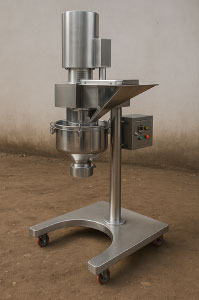
A multi mill is a rotor-and-screen size reduction machine. Swing beaters, each with a knife edge on one side and an impact edge on the other, rotate inside a perforated screen. Material enters through a hopper, is cut or crushed, and leaves only once it is small enough to pass the screen.
In a tablet plant it does three jobs:
- Wet mass sizing: after granulation in a rapid mixer granulator, the damp mass is milled through a coarse screen so it dries evenly in the fluid bed or tray dryer.
- Dry granule sizing: dried granules and lumps are brought to the target size distribution before lubrication and compression.
- De-lumping: APIs and excipients that have caked in storage are broken down before dispensing or blending.
Granule size drives everything that follows. Oversized granules dry unevenly and can cause weight variation. Too many fines hurt flow and can contribute to capping or sticking.
How a Multi Mill Works: Step by Step
- Feeding: material is charged through the hopper into the milling chamber. A steady feed rate keeps the rotor load and heat generation stable.
- Rotor action: the rotor carries swing beaters and turns at the set speed, throwing material against the screen.
- Knife or impact edge: the knife edge cuts and shears damp or fibrous material. The impact edge crushes brittle, dry granules. Reversing the direction of rotation changes which edge meets the product.
- Screen sizing: only particles smaller than the screen perforations pass through. Scraper blades keep the screen surface clear.
- Discharge: milled product drops into the receiving container or drum below.
What controls particle size?
Three settings matter most:
- Screen size has the strongest effect on final granule size.
- Rotor speed: higher speed gives finer material but more fines and more heat; lower speed is gentler on sensitive formulations.
- Blade direction: knife-forward for cutting wet mass, impact-forward for dry granules.
Key Features of a Multi Mill for Pharmaceutical Tablets
- Interchangeable perforated screens: a range of hole sizes lets you match the screen to the formulation, giving uniform granules and a tighter size distribution.
- Reversible rotor direction: one machine handles wet mass and dry granules, which helps keep granule properties consistent across stages.
- Adjustable rotor speed: tuning speed to the product helps limit fines, supporting better flow and steady die fill. A VFD option is available.
- Swing beaters with knife and impact edges: the right edge for the material reduces over-milling, which supports consistent tablet weight and hardness.
- Short residence time in the chamber: material passes through quickly, so heat build- up stays low. This matters for heat-sensitive APIs and binders.
- Easy-to-dismantle chamber, screen and beaters: faster cleaning and changeover, and lower cross-contamination risk between products.
- Enclosed milling chamber with hopper and discharge: less airborne dust and less operator exposure.
Applications
- Pharmaceutical tablets: wet mass milling, dry granule sizing and lump breaking for immediate-release and other granulated formulations.
- Nutraceuticals: sizing of vitamin, mineral and protein blends that clump or absorb moisture.
- Herbal and Ayurvedic formulations: milling of dried extracts and fibrous or sticky powders, where screen choice and speed need trial.
- R&D and pilot batches: small-scale milling to confirm screen and speed before scale- up.
Technical Specifications
| Parameter | SAPMM-100 (lab / pilot class) | SAPMM-200 (production class) | SAPMM-300 (high-output class) |
|---|---|---|---|
| Indicative capacity | Approx. 1–50 kg/hr | Approx. 50–200 kg/hr | Up to approx. 300 kg/hr |
| Motor power | Approx. 1 HP (0.75 kW) | Approx. 3 HP (2.2 kW) | Approx. 5 HP (3.7 kW) |
| Rotor speed | Up to approx. 2,800 RPM | Approx. 750–3,000 RPM | Approx. 750–3,000 RPM |
| Screen sizes (perforated) | Approx. 0.5–12 mm | Approx. 0.5–12 mm (some designs to 25 mm) | Approx. 0.5–12 mm |
| Beaters | Knife and impact edges, plus scrapers (typically 8 + 2) | Knife and impact edges, plus scrapers (typically 12 + 2) | Knife and impact edges, plus scrapers (typically 12 + 2) |
| Screen chamber | Approx. 128 mm ID | Approx. 260 mm ID × 135 mm height | [CONFIRM] |
| Hopper capacity | - | - | - |
| Contact parts | SS 316 | SS 316 | SS 316 |
GMP-Ready Construction and Documentation
- Design: built to cGMP principles, with a smooth, crevice-minimised chamber to support cleaning.
- Materials: all product-contact parts are SS 316. Non-contact body material and surface finish values Ra 0.4 or better.
- Cleanability: the hopper, screen and beaters can be dismantled for cleaning. Gasket material and CIP/WIP compatibility.
- Safety and dust control: interlocks, guarding and dust-containment options.
- Validation support: DQ, IQ/OQ and PQ documentation is available for the machine. Material certificates and calibration records.
Choosing the Right Model: A Buyer's Checklist
- Batch size and hourly throughput: match the model to your granulator output and the time window you have for milling.
- Wet, dry or both: if both, confirm reversible rotation and a screen set for each stage.
- Target granule size: list the screens you need, and ask for trial milling on your product.
- Heat sensitivity: check speed range and whether variable speed is needed.
- Product character: sticky, fibrous or hygroscopic material may need different screens and more frequent cleaning.
- Cleaning and changeover: consider how many products share the machine.
- Hazardous area: state if flameproof electricals are needed.
- Documentation: confirm the validation package (DQ, IQ/OQ, PQ) your QA team requires.
Why Choose SA Pharma Process Equipment
- Application guidance: we help you pick the screen set and speed range for your product.
- Customisation: screen sizes, drive options and discharge arrangements can be matched to your line.
- Spares: beaters, screens and scraper blades are available as replacement parts
- Installation and qualification support: commissioning supported by DQ, IQ/OQ and PQ documentation.
- Operator and maintenance training: training on setup, cleaning and screen changes.