WFI Storage Tank
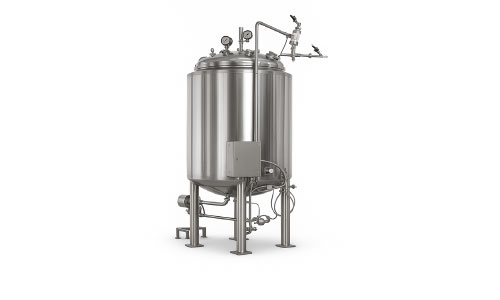
A WFI storage tank holds Water for Injection after it leaves the generator (a multi-column distillation plant or still) and before it enters the distribution loop. It is the buffer that keeps your points of use supplied while the still runs at its own pace.
Because the tank holds water that ends up in injectables, its design affects microbial control, endotoxin risk and, in the end, audit outcomes. A poorly drained base, a rough weld or an unprotected vent can undo the work of the entire generation plant.
SA Pharma Process Equipment, based in Ahmedabad, manufactures the pharmaceutical WFI tank in SS316L for plants across India, in vertical and horizontal orientations.
How Our WFI Storage Tank Works
Water for Injection from the still enters the tank and is held for supply to the distribution loop. A recirculation pump draws water from the tank outlet, sends it through the loop and returns it to the tank, usually through a spray ball. Continuous flow prevents stagnation, which is where biofilm starts.
- Temperature maintenance:In hot WFI storage, the water is typically kept at around 70–80 °C or above, a range at which microbial growth is strongly suppressed. A heating or jacket arrangement, together with insulation, holds the set temperature. The exact temperature is set by your validated process and URS.
- Vent filtration: As water is drawn off, air must enter the tank. A 0.2 µm hydrophobic vent filter lets air in while blocking microorganisms and particles. In hot systems the filter housing is normally heat- traced or jacketed so condensation does not wet the membrane.
- Sanitization:The tank is designed to support periodic hot-water or pure steam sanitization and CIP/SIP, with spray ball coverage and full drainability so no pockets hold residual water.
Key Design Features
- SS316L contact surfaces: Molybdenum-bearing 316L resists the pitting and rouging that hot, high-purity water can cause, protecting water quality over years of service.
- Electropolished interior, Ra ≤ 0.8 µm: A smooth, passivation-friendly surface gives microorganisms fewer places to anchor and makes cleaning easier to demonstrate.
- Sloped, fully drainable bottom:Complete drainage leaves no standing water after a CIP or sanitization cycle, which removes a classic audit observation.
- Spray ball for full internal coverage: Wetting the entire inner surface and the headspace, including the area around nozzles, is what makes a CIP cycle repeatable and verifiable during validation.
- 0.2 µm hydrophobic vent filter with heated or jacketed housing:It protects the tank from airborne contamination and avoids filter blockage caused by condensate.
- Dead-leg-free sanitary connections:Nozzles are kept short and positioned to drain, so there are no stagnant zones where endotoxin or biofilm can build.
- Flush-mounted, sanitary instrument ports:Level and temperature sensors fitted without crevices keep measurement accurate without creating a cleaning problem.
- Rupture disc or safety device: Protection against over-pressure or vacuum during steam sterilization and cool-down, selected to your design conditions.
- SS304 cladding over insulation: Insulation reduces heat loss in hot storage, and the cladding gives a washable, hygienic outer shell for the plant room.
- Vertical or horizontal orientation: Choose the layout that suits your available floor space, ceiling height and pump suction requirements.
Technical Specifications
| Parameter | Specification |
|---|---|
| Capacity | 500 L to 10,000 L (working volume as per URS) |
| Orientation | Vertical or horizontal |
| Material of construction (contact parts) | SS316L |
| Material of construction (non-contact / cladding) | SS304 |
| Internal finish | Polished, Ra ≤ 0.8 µm |
| External finish | As per URS |
| Design pressure and temperature | As per URS (including vacuum and steam sanitization conditions where required) |
| Jacket / limpet | Jacket or limpet type as per URS for hot WFI storage |
| Insulation and cladding | Insulation as per URS; SS304 cladding |
| Vent filter and housing | 0.2 µm hydrophobic vent filter; housing type as per URS |
| Spray ball | Static or rotary type for full internal coverage, as per URS |
| Rupture disc / safety device | As per design conditions |
| Level measurement | As per URS (e.g., level transmitter, sight/level options) |
| Temperature measurement | Sanitary RTD (PT100) as per URS |
| Inlet / outlet / return connections | Sanitary tri-clover or as per URS |
| Legs / load cells | Support legs; load cells optional |
| Design code | As per URS; designed in line with cGMP principles |
| Documentation | DQ, IQ/OQ, PQ, material test certificates (MTCs), Ra reports |
Applications in Pharmaceutical & Life Sciences
- Injectables and parenterals:WFI is the solvent and the final rinse for large and small volume injectables, so the storage tank feeds the most critical points of use.
- Ophthalmic preparations: Sterile eye drops and ointments need low-endotoxin water as a formulation base.
- Vaccines and biologics:Buffer and media preparation depend on a consistent, controlled WFI supply.
- CIP final rinse:Equipment such as reactors and filling lines is rinsed with WFI after cleaning, which demands steady loop pressure and temperature.
- API manufacturing:Sterile API and late-stage steps use WFI for process and rinse water.
- Pure steam generation feed:WFI tanks supply feed water to pure steam generators in plants that use both utilities.
- Compounding and formulation areas:Large batch preparation vessels draw from the loop fed by this tank.
Compliance & Regulatory Alignment
The tank is designed and built in line with cGMP principles: smooth, cleanable surfaces, drainable geometry, material traceability and documented fabrication. This is the standard that inspectors apply when they walk through a pharmaceutical water system.
Pharmacopoeial and regulatory guidance on water for pharmaceutical use, such as the pharmacopoeias, WHO guidance and EU GMP expectations, sets the water quality your system must deliver. The tank is one part of meeting that requirement, and your overall system validation demonstrates it.
Customization Options
Every plant has a different layout and URS, so the tank is configured rather than picked from a fixed list.
- Capacity: from 500 L to 10,000 L.
- Orientation: vertical or horizontal.
- Jacket or limpet type:for hot WFI storage, and insulation thickness.
- Instrumentation: level, temperature and pressure transmitters, and sight glasses.
- Vent filter housing:heated or jacketed, to your preference.
- Nozzle layout and connection sizes:to match your loop design
- Spray ball type:and positions.
- Support: legs, with load cells if you want weight-based level measurement.
- Automation:integration with your PLC/SCADA, to be discussed against your system.
Validation & Documentation Support
Each tank is supplied with a documentation set built for qualification:
- DQ (Design Qualification) showing the design meets your URS.
- IQ/OQ protocols for installation and operational checks.
- PQ documentationto support performance qualification in your water system.
- MTCs (Material Test Certificates) that trace the SS316L back to its source.
- Ra reportsrecording the measured internal surface roughness
Having these ready at delivery means your validation team can start from complete records instead of collecting them, which shortens qualification time and reduces the chance of gaps appearing at inspection.
Why Choose SA Pharma Process Equipment
- Local manufacturing in Ahmedabad, with supply across India, so your team can discuss design directly with the people who build the tank.
- Capacity range of 500 L to 10,000 Lin both vertical and horizontal configurations.
- Electropolished interior to Ra ≤ 0.8 µm,with measured values reported to you.
- Full qualification documents (DQ, IQ/OQ, PQ) plus MTCs and Ra reports as part of the supply.
- SS316L contact partswith SS304 cladding, built in line with cGMP principles.