Membrane Filter Holder
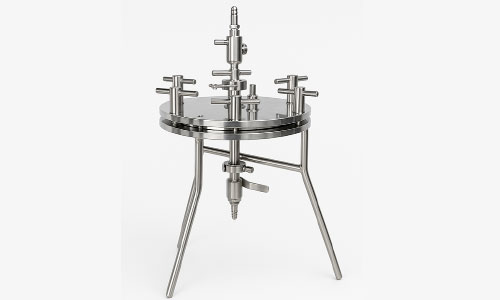
A membrane filter holder for pharmaceutical use does one job that quality and process teams cannot afford to get wrong: it keeps a membrane flat, sealed and ready for sterile work while liquid or gas passes through it. S A Pharma Process Equipment manufactures Membrane Filter Holders in SS 316L and SS 304 for QC laboratories, microbiology teams, validation engineers and pilot plants across India. Choose inline, pressure, vacuum, tri-clamp or manifold-mounted formats to suit your sample, membrane and cleaning routine. Each unit is designed so the membrane seats evenly, the gasket seals reliably, and the holder strips down quickly for cleaning between runs.
Key Features
- SS 316L and SS 304 construction: choose 316L for corrosion-critical, product-contact duty and 304 for general-purpose work, so you pay only for the grade your application needs.
- Polished product-contact surfaces: smoother surfaces reduce microbial adhesion and make cleaning validation easier.
- Five configurations, one product family: inline, pressure, vacuum, sanitary tri-clamp and manifold-mounted versions let you standardize on one supplier across QC and process areas.
- Flat, supported membrane seat: a rigid support screen keeps the membrane level under pressure or vacuum, which protects it from tearing and gives an even flow across the surface.
- Gasket choice to suit your chemistry: silicone, EPDM, PTFE or Viton seals let you match the elastomer to your solvent, temperature and sterilization method.
- Autoclave-ready design: the holder can be sterilized with the membrane in place, which shortens setup and reduces handling steps before a sterility test.
- Simple strip-down for cleaning: a small number of parts and no hidden dead legs make disassembly quick and visual inspection straightforward.
- Range of membrane diameters: from 47 mm for routine QC filtration to 293 mm for larger- volume and pilot-scale work.
Pharmaceutical Applications
- Sterility testing: the holder captures any microorganisms on the membrane while the product is rinsed away, so the membrane can be transferred to culture media. A cleanable, autoclavable holder keeps the test environment controlled.
- Bioburden and microbial limit testing: filtering a measured sample volume concentrates organisms on the membrane for counting. A leak-free seal and even membrane seating keep the count representative.
- Particulate analysis: liquids or rinse samples are filtered onto a membrane for microscopic or gravimetric counting. A smooth, clean holder avoids adding particles that would distort the result.
- Clarification and sterile filtration of small-volume parenterals: at lab and pilot scale, a pressure or inline holder carries a membrane filter safely at working pressure, helping you evaluate filter performance before scale-up.
- Buffer and media filtration: a holder with a large membrane area gives a practical way to prepare buffers and culture media with fewer filter changes.
- Water-for-injection (WFI) sampling: a sanitary, tri-clamp connection allows controlled sampling from a loop or point of use, with membranes retrieved for microbial analysis.
- Filter integrity testing: a holder that supports a defined membrane and wetting procedure helps teams run bubble-point or similar checks reproducibly.
- R&D and pilot-scale work: changing membrane diameters across one holder family lets development teams scale a filtration step from bench to pilot without redesigning the setup.
Technical Specifications
| Parameter | 47 mm | 90 mm | 142 mm | 293 mm |
|---|---|---|---|---|
| Membrane diameter | 47 mm | 90 mm | 142 mm | 293 mm |
| Effective filtration area | ~9.6 cm² | — | ~113–130 cm² | — |
| Max operating pressure | — | — | Typically 7 bar differential, up to 14 bar inlet | Typically 5–7 bar differential, up to 8.6 bar inlet |
| Temperature range | — | — | — | — |
| Connections | — | — | 1.5" tri-clamp or hose barb (typical) | 1.5" sanitary flange or G1–G1½ (typical) |
| Body material | SS 316L / SS 304 | SS 316L / SS 304 | SS 316L / SS 304 | SS 316L / SS 304 |
| Gasket / O-ring options | Silicone, EPDM, PTFE, Viton | Silicone, EPDM, PTFE, Viton | Silicone, EPDM, PTFE, Viton | Silicone, EPDM, PTFE, Viton |
| Sterilization compatibility | Autoclave | Autoclave | Autoclave | Autoclave |
How It Works
- Assemble: fit the gasket into the lower body and place the support screen on the outlet side. Wet the screen lightly if your procedure calls for it.
- Place the membrane: using sterile forceps, lay the membrane flat and centered on the support screen, correct side up. Avoid touching the filtering surface.
- Close and seal: attach the upper body or funnel and tighten the clamp, wing nuts or tri-clamp until the gasket is evenly compressed.
- Filter: connect the inlet and outlet, then apply vacuum or pressure within the rated limits. The liquid passes through the membrane and any retained particles or organisms stay on its surface.
- Open and clean: release pressure, open the holder, transfer the membrane with sterile forceps (for example, onto culture media), then dismantle the parts for cleaning.
Why Choose S A Pharma Process Equipment
- Pharma-focused manufacturing: we build process and laboratory equipment for regulated users, so our designs reflect how QC and validation teams really work.
- Configuration and material choice: inline, pressure, vacuum, tri-clamp and manifold-mounted types in SS 316L or SS 304, with a choice of gasket materials.
- Customization: non-standard connections, diameters and fittings can be built to fit existing skids or manifolds.
- After-sales and export support: spare gaskets, documentation and application guidance after delivery, for customers in India and abroad.