Ointment Manufacturing Plant
An ointment manufacturing plant is the production line that turns oils, waxes, water and active ingredients into smooth, stable semi-solid products. S.A. Pharma builds this plant for pharmaceutical ointments and creams, and it suits body lotions and skincare formulations just as well.
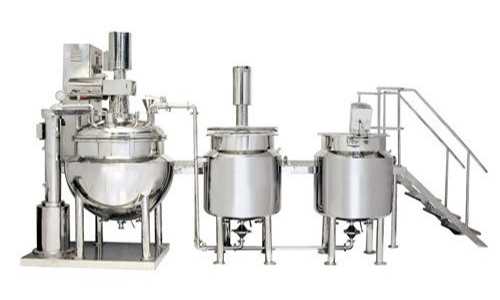
Capacities run from 20 kg development batches up to 1,000 kg commercial batches, so one supplier can serve a start-up as readily as an established formulation house. The plant is organised into three main sections, linked by product transfer and homogenization units that keep day-to-day operation simple for the shop-floor team.
If you are comparing an ointment plant manufacturer in India that designs to cGMP expectations, this page walks through the components, process, features and specifications worth checking before you request a quotation.
What Is an Ointment Manufacturing Plant?
An ointment manufacturing plant is an integrated set of vessels, pumps, piping and controls used to prepare semi-solid dosage forms. Instead of mixing everything in one tank, the plant prepares the oil-based and water-based parts of a formula separately, then combines them under controlled conditions.
This staged approach gives better control over melting, dissolving and dispersing each ingredient. Once the two phases are joined, high-shear emulsification under vacuum produces a uniform, air-free base that is cooled and moved on for storage or filling.
A well-designed pharmaceutical ointment plant matters because semi-solids are unforgiving. Poor mixing leads to grittiness, phase separation or uneven drug content, and these faults show up as batch rejections. A purpose-built cream manufacturing plant removes much of that risk by fixing temperature, speed, vacuum and time at repeatable values.
The same equipment handles ointments, creams, gels, lotions and other semi-solid products, which makes it a practical choice for pharma, cosmetic and personal care units.
Key Features
Each component has a defined job in the process. Together they form a closed, easy-to-clean system.
- Manufacturing vessel: The main ointment manufacturing vessel where the two phases are combined, emulsified, homogenized and cooled. Agitators are top mounted, while the high- speed emulsifier is mounted at the bottom or provided in-line, depending on your requirement.
- Wax phase vessel: Melts and blends waxes, fats, oils and other oil-soluble ingredients before they are sent to the main vessel.
- Water phase vessel: Dissolves and heats water-soluble ingredients, preservatives and humectants as a separate pre-mix.
- Storage vessel: Holds the finished semi-solid until it is released to filling or tube-filling lines.
- Vacuum pump: Removes entrapped air during mixing, giving a denser, glossier product with better stability.
- Transfer pumps: Move each phase into the manufacturing vessel and carry the finished batch onward.
- Interconnecting piping: Electro-polished SS 316 pipework that links the vessels with smooth internal surfaces that are easy to clean.
- Working platform: A platform running along the length of the plant that gives operators and maintenance staff safe access.
- Centralised control panel: One point of control for the plant's functions, with a touch-screen HMI.
Working Process
The plant follows a logical sequence. Exact set points vary by formulation, so the values below are for understanding only.
- Wax phase preparation: Oil-soluble ingredients are charged into the wax phase vessel and heated until fully melted and uniform.
- Water phase preparation: Water, preservatives and water-soluble ingredients are heated and dissolved in the water phase vessel.
- Vacuum charging of the main vessel: The manufacturing vessel is brought under vacuum so that both phases can be drawn or pumped in with minimal air entrainment.
- Phase transfer: The wax and water phases are transferred into the manufacturing vessel in the sequence defined by the formula.
- Emulsification and homogenization: The high-speed emulsifier breaks the internal phase into fine droplets while the agitator and scraper keep the whole batch moving, including material near the vessel wall.
- Active and heat-sensitive additions: Actives, perfumes or heat-sensitive ingredients are added once the batch has cooled to a suitable temperature.
- Cooling: Jacketed cooling brings the batch down while slow agitation maintains uniformity as the structure builds.
- Discharge: The finished product is transferred under vacuum or by pump to the storage vessel, or directly to the filling section.
- Cleaning: Spray balls in each vessel support cleaning-in-place between batches, which reduces manual cleaning effort.
Salient Features
- cGMP-compliant design: Layout, surfaces and construction follow cGMP norms.
- Quality materials: All vessels are fabricated from SS 316 or SS 316L stainless steel.
- Flexible heating: Steam or electric heating can be chosen to match your utilities.
- Hygienic piping: All interconnecting pipes are made from electro-polished SS 316.
- Choice of emulsifier position: Top-mounted agitators with a bottom-mounted or in-line high-speed emulsifier.
- Protected mechanical seals: Seals are fitted with water flow switches to guard against dry running.
- Food-grade gaskets: Silicone gaskets are used at all connections and interfaces.
- Built-in CIP spray balls: Every vessel has a CIP spray ball for easier cleaning.
- Operator and plant safety: Necessary safety mountings are provided on the equipment.
- Maintenance access: A working platform along the plant's length simplifies inspection and servicing.
Automation and Process Control
Automation is what turns a good set of vessels into a repeatable production system. The plant is controlled through a PLC with an HMI touch screen, so operators manage the whole sequence from a single point.
- PLC and HMI: All functions are managed through PLC control with a touch-screen interface.
- SCADA option: PLC-based packages with touch-screen MMI and SCADA can be selected to suit your application and data needs.
- Level measurement: Level is controlled through capacitance probes or electronic load cells.
- Digital process parameters: Process time, agitator speed, temperature, pressure and level are displayed and controlled digitally.
- Recipe and parameter storage: The control package can store process parameters, making set-up quicker and batch consistency easier to maintain.
- Integrated options: Optional features are supplied fully integrated into the control system with appropriate safety interlocks.
Optional Features for Greater Flexibility
- Heating, cooling and insulated jackets with temperature control and safety equipment
- Semi contra-rotary agitator with an open-slot scraper design
- Hydraulic lifting of the manufacturing vessel top dish for easy product recovery and cleaning
- Separate pre-mix vessels for the wax and water phases
- Process piping with a transfer panel design for automated plants
Technical Specifications
| Parameter | Details |
|---|---|
| Capacity range | 20 kg to 1,000 kg |
| Applications | Ointments, creams, gels, body lotions and skincare preparations |
| Plant sections | Three main sections plus product transfer and homogenization units |
| Material of construction (vessels) | SS 316 / SS 316L |
| Interconnecting piping | Electro-polished SS 316 |
| Gaskets | Silicone |
| Heating | Steam or electric |
| Cooling / jackets | Heating, cooling and insulated jackets with temperature control (optional) |
| Agitation | Top-mounted agitator; semi contra-rotary with open-slot scraper (optional) |
| Emulsifier / homogenizer | Bottom-mounted or in-line high-speed emulsifier |
| Vacuum | Vacuum pump supplied |
| Cleaning | CIP spray ball in each vessel |
| Seal protection | Mechanical seals with water flow switches |
| Level control | Capacitance probe or electronic load cells |
| Control system | PLC with HMI touch screen; SCADA optional |
| Controlled parameters | Process time, agitator speed, temperature, pressure, level |
| Vessel top dish | Hydraulic lifting |
| Design standard | cGMP norms |
| Surface finish (internal) | Ra 0.8um or better |
Why Choose S.A. Pharma as Your Ointment Plant Manufacturer
S.A. Pharma is a ointment manufacturing plant supplier based in Ahmedabad, Gujarat, with experience in designing ointment, cream and lotion preparation vessels.
- Process knowledge across ointments, creams and lotions
- Capacities from 20 kg to 1,000 kg under one roof
- Configurations that adapt to your formulation, utilities and automation level
- A single source for the cream and lotion plant, in-line homogenizer and related process equipments
If you are searching for an ointment plant manufacturer in Ahmedabad, Gujarat, our team can review your batch size, product range and layout before recommending a configuration.